
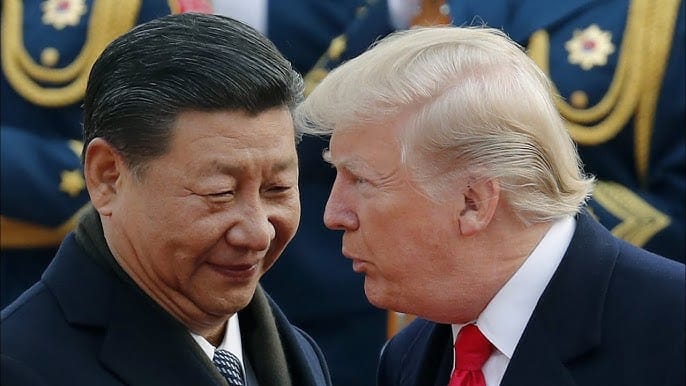
The recent summit between U.S. President Donald Trump and (US-China) Chinese President Xi Jinping in Busan, South Korea, produced immediate economic relief. The leaders agreed to a series of reciprocal concessions. This move successfully pulled the world’s two largest economies back from the edge of an all-out trade war. President Trump hailed the meeting as a “great success,” suggesting a diplomatic reset. However, trade relations are not truly “back on track.” They are instead in a state of managed hostility. This current détente is merely a fragile, temporary truce. It postpones rather than resolves the deep, structural conflicts that define the rivalry. US-China
The Illusion of Progress: The Short-Term Gains US-China
The agreements announced following the Busan meeting were highly specific. They target immediate political and economic pain points. This focus created the illusion of a comprehensive deal.
Tariff Rollbacks and Farm Relief
The most immediate victory was the reciprocal easing of tariffs. President Trump announced a reduction in the overall U.S. tariff rate on Chinese goods. It will drop from 57% to 47%. Crucially, this change includes halving the 20% tariff linked to fentanyl precursor chemicals. This measure rewards China’s pledge. Beijing committed to intensifying efforts to curb the flow of the deadly opioid. Furthermore, China committed to immediately resuming purchases of American soybeans. They also pledged to buy other agricultural products. This move provides a vital lifeline to U.S. farmers. They have been battered by retaliatory Chinese boycotts. US-China
Rare Earths: A One-Year Reprieve
The tech sector received a major reprieve concerning rare earth minerals. China agreed to suspend its most recent export controls for one year. These controls threatened to cripple global manufacturing. They would have severely damaged defense and high-tech industries reliant on Chinese supply. In a reciprocal action, the U.S. paused several new export restrictions on Chinese affiliates. This suspension is critical. It allows global supply chains essential time to breathe. However, this agreement is extendable annually. This means the leverage remains firmly in Beijing’s hands. It underscores the temporary nature of the fix.
The Structural Obstacles: Why The Track Remains Broken US-China
Despite the headline-grabbing announcements, three core structural obstacles prevent a true return to normal trade relations. These issues have rooted in security and ideology. They have not easily fixed by transactional deals. US-China
The Unresolved Technology War
The rivalry over technology remains the deepest chasm. The U.S. will continue to aggressively contain China’s access to advanced semiconductors. President Trump confirmed that the most powerful chips, like Nvidia’s Blackwell AI chip, would not be sold to China. This policy has driven by national security concerns. Washington seeks to prevent China’s technological development in military and AI spheres. The U.S. is prioritizing technological dominance. It does this even at the cost of commercial opportunities. Therefore, the fundamental decoupling in strategic tech sectors will continue. This makes a full trade normalization impossible.
The Persisting Tariff Wall US-China
Trade tariffs remain significantly high. The average U.S. tariff rate on Chinese imports, even after the reduction, is still 47%. This is dramatically higher than the rate before the current trade war began. It remains a tax on American businesses and consumers. Furthermore, numerous older tariffs remain in place. No resolution has announced on the existing Section 301 and 232 tariffs. This continued tariff barrier acts as a constant drag on trade volumes. It solidifies the “new normal” of highly taxed bilateral trade. This is not the free-flowing relationship of the past.
Lack of Trust and Enforcement
Trust is the critical missing element. Chinese state media confirmed a consensus. They urged officials to “refine and finalize” the agreements. This suggests crucial details are still missing. Historically, China failed to meet its purchasing targets. It missed its commitments under the 2020 “Phase One” deal. Consequently, the U.S. has little confidence in verbal promises alone. This lack of trust mandates the deal’s one-year renewal clause. It means the relationship will be subject to a continuous cycle of renegotiation and potential threats. The inherent rivalry prevents the stability needed for long-term investments.
Geopolitical Context: Managing Volatility US-China
The agreement should be viewed as an attempt to manage volatility. It is not a sign of renewed friendship. Both leaders had strong domestic incentives to de-escalate.
Domestic Pressures on Trump and Xi
President Trump needed a win for the U.S. farm sector. The soybean agreement delivers this political talking point. He also needed to avoid the imposition of a disastrous 100% tariff hike. This would have damaged the U.S. economy and markets. President Xi Jinping, meanwhile, sought stability. The Chinese economy faces challenges, including slowing growth. The rare earths reprieve buys time for Beijing. It can now focus on internal economic reforms. Therefore, the deal was pragmatic for both sides. It reduced immediate risk. It served short-term domestic political needs.
The Broader Geopolitical Silence
The two leaders deliberately avoided the most contentious geopolitical issues. For instance, the status of Taiwan has reportedly not discussed. Human rights issues in Xinjiang have also excluded. The U.S. continues to press China on its relationship with Russia. The silence on these structural issues confirms the reality. The competition is too deep to resolve quickly. The trade truce is a diplomatic maneuver. It has designed to create space for future, more contentious discussions.
A New Era of Subscription Diplomacy US-China
Are U.S.-China trade relations back on track? The candid answer is no. They have entered a new era. This era has defined by what some analysts call “subscription diplomacy.” The relationship operates on a year-to-year, pay-for-play model. Tariffs remain high. Technological separation is accelerating. Trust is minimal. The Busan agreement provided an essential ceasefire. It proved that both sides recognize the high cost of open confrontation. Moving forward, the relationship have characterized by limited cooperation in areas of mutual convenience. The structural rivalry, however, remains the defining feature. Businesses must prepare for continued uncertainty. They must plan for a trade dynamic where the next round of negotiations is always just around the corner. US-China
Read More Articles Click Here. Read Previous Article Click Here.
About The Author







Leave a Reply