
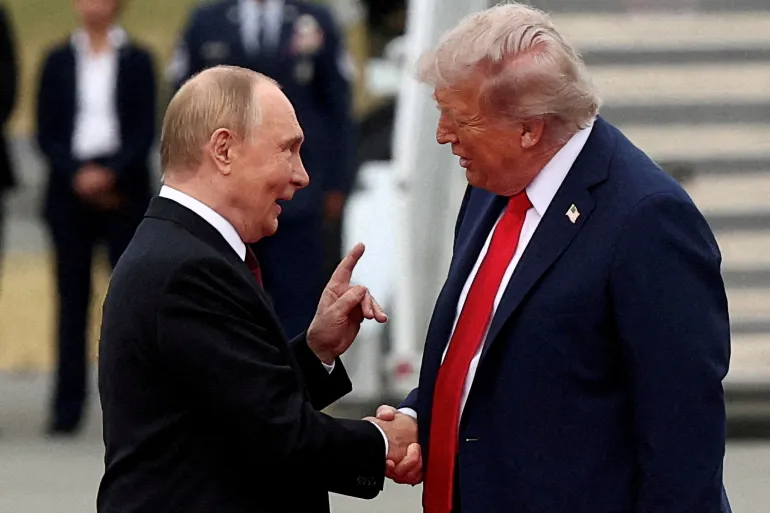
A truly audacious proposal has captured global attention. A senior Kremlin envoy recently pitched an enormous infrastructure project. He suggested building an undersea rail and cargo tunnel. This tunnel would physically connect Russia and the United States. Furthermore, he proposed naming this massive undertaking the “Putin-Trump Tunnel.” This idea, floated amid high geopolitical tension, aims to “symbolise unity.” It comes just after a phone call between the two nations’ leaders. Clearly, the proposal is more than just engineering. It is a bold statement of diplomatic intent.
The Vision: A Bridge Across the Strait Putin-Trump
The proposed tunnel would span the Bering Strait. This strait separates Russia’s Chukotka region from Alaska. At its narrowest, the strait is only 51 miles (82 km) wide. The idea is not entirely new. However, this specific, highly-publicized pitch is significant. It links a century-old dream to modern political dynamics. Kirill Dmitriev, the head of Russia’s RDIF sovereign wealth fund, put forth the idea. He is also President Vladimir Putin’s investment envoy. Dmitriev claims the 70-mile (112 km) link could be built quickly. He suggests completion in under eight years. He estimates the cost at a surprisingly low $8 billion.
The Elon Musk Connection
Dmitriev’s proposal includes a compelling twist. He suggests leveraging new tunneling technology. Specifically, he named Elon Musk’s The Boring Company. This company’s expertise, he argues, could slash traditional costs. Consequently, this detail transforms the pitch. Past estimates for such a project were enormous. They ranged from $50 billion to over $100 billion. The drastically reduced $8 billion figure, however, gives the idea new life. Dmitriev actively pitched the idea to Musk on social media. He positioned the tunnel as a historic link. It would connect the Americas and the Afro-Eurasia landmass.
A Cold War Echo
Interestingly, this modern proposal echoes history. Dmitriev compared the idea to a Cold War-era concept. That earlier idea was the “Kennedy-Khrushchev World Peace Bridge.” This comparison frames the tunnel as a continuation. It makes the tunnel a new opportunity for de-escalation. Therefore, the symbolic value is immense. It signals Moscow’s desire for cooperation. It attempts to reframe the narrative. This reframing shifts focus away from global confrontation. It focuses instead on “connectivity” and shared future goals.
The Geopolitical Context: More Symbol than Substance Putin-Trump
The timing of the tunnel proposal is crucial. It followed a recent phone call between the two presidents. During that call, they agreed to meet soon. They planned to discuss the ongoing conflict in Ukraine. Thus, the tunnel proposal functions as a diplomatic signal. It is a grand gesture of goodwill. It tries to project an image of constructive engagement.
However, the political response has been mixed. President Donald Trump called the idea “interesting.” He said he would “have to think about that.” Conversely, Ukrainian President Volodymyr Zelensky expressed clear disapproval. He stated simply: “I’m not happy with this idea.” This reaction highlights the complex reality. The tunnel, even as an idea, becomes a pawn. It plays a role in a larger game of international chess. It seeks to solidify a narrative of U.S.-Russia unity. This narrative would surely undermine Western alliances against Russia.
Hurdles Beyond Engineering
The political and logistical challenges are huge. Firstly, current sanctions present a major obstacle. These sanctions target Russia’s economy and finance. They make international investment difficult. Secondly, diplomatic tensions are extremely high. Building a joint, permanent, physical link requires deep trust. Such trust is currently absent.
Beyond politics, practical concerns are immense. The Russian side of the strait is sparsely populated. Furthermore, it severely lacks infrastructure. There are no railways for thousands of miles. Connecting the tunnel to North America requires thousands of kilometers of new rail. This supporting infrastructure would cost tens of billions of dollars more. Chukotka’s roads are sparse at best. These infrastructure gaps dwarf the tunnel’s proposed cost.
The Hard Reality: Feasibility and Economics Putin-Trump
The project faces severe technical and economic skepticism. Many experts doubt the viability of the $8 billion cost estimate. They argue The Boring Company’s technology has not been proven. It has not been tested on a project of this scale. The proposed tunnel would be 70 miles long. Therefore, it would be more than double the length of the Channel Tunnel. That European project cost far more and faced easier geology.
Environmental and Engineering Obstacles
The Bering Strait crossing is inherently difficult. Firstly, the environment is extremely harsh. The area is just south of the Arctic Circle. Winter temperatures plunge well below freezing. Construction would be restricted to a few months each year. Secondly, the strait is seismically active. It sits near tectonic plate boundaries. This poses significant engineering risks. Tunnels must withstand potential earthquakes. Thirdly, the surrounding regions are covered in permafrost. Building thousands of kilometers of access rail requires specialized, expensive technology. This technology must stabilize the ground. It must prevent the rail line from shifting.
Trade and Economic Justification
Economically, the tunnel’s necessity is questioned. Historically, U.S.-Russia trade volumes are low. Most of Russia’s exports are energy products. These are transported more easily by ship. Analysts note that liquefied natural gas is easier to ship than to move by rail. Consequently, the tunnel’s true economic driver is missing. It would require a massive shift in global trade routes. It needs huge trade between Asia and North America. While shortening shipping times is appealing, the cost remains prohibitive. Critics suggest the project is “more symbolic than practical.” It is a beautiful vision, yet one lacking commercial justification.
The Path Forward: Dialogue and Dream Putin-Trump
The “Putin-Trump Tunnel” remains firmly in the realm of grand concepts. However, it has successfully opened dialogue. It has become a concrete topic for discussion. President Trump’s “interesting” comment keeps the door ajar. Dmitriev confirmed that a feasibility study is underway. This research is funded by the RDIF.
Ultimately, the proposal is a test. It tests the potential for U.S.-Russia cooperation in the current era. It recognizes a core fact. The dream of connecting the continents is enduring. Therefore, the idea, however distant, continues to serve a diplomatic function. It projects an image of hope. It hints at a future where confrontation gives way to connectivity. For now, the “Putin-Trump Tunnel” is a powerful metaphor. It is a symbol of a unity that must first be achieved in the political arena. Only then can it possibly be built under the sea.
Read More Articles Click Here. Read Previous Click Here.
About The Author






Leave a Reply